
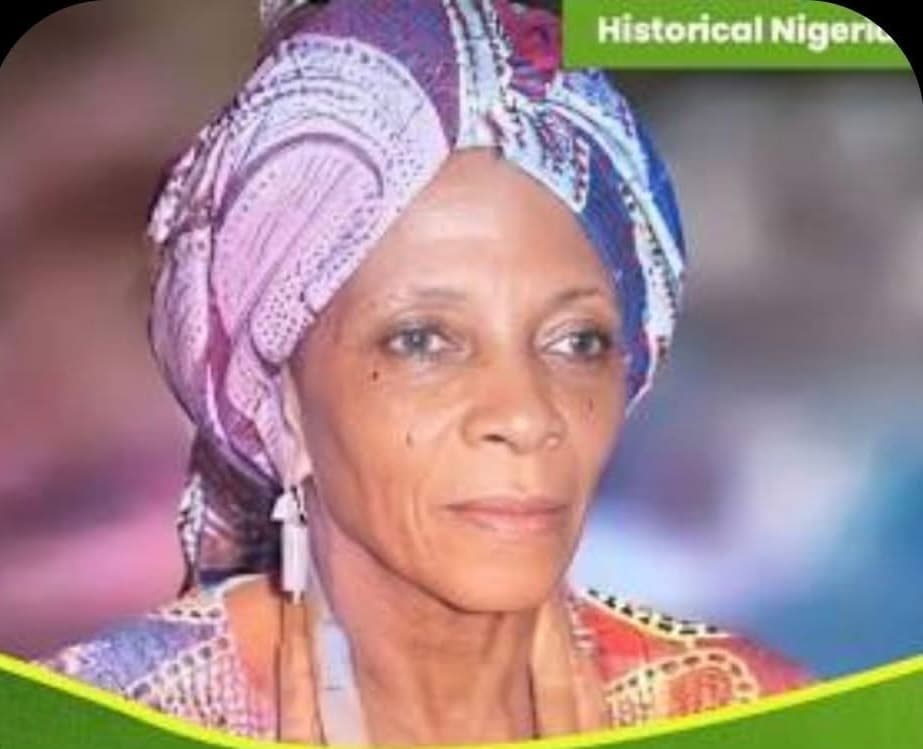
Long before the microphones, recording studios and commercial music that would later transform Nigeria’s music industry, a woman’s voice was already carrying the history of a people from one generation to another.
Her name was Hajia Fatima Lolo.
Born in 1903 in Pategi, in present-day Kwara State, Fatima Lolo would go on to spend much of her remarkable life in Bida, Niger State, where her talent, discipline and deep knowledge of Nupe traditions earned her a place within the royal court and the wider Nupe Kingdom.
She was not merely a musician.
She was a storyteller, poet, historian, social commentator and custodian of a culture that had long relied on oral tradition to preserve its identity.
At a time when women faced considerable barriers to public artistic expression, Lolo carved out a distinctive place for herself through music.
Her performances were marked by commanding lead vocals, supported by female choruses, rhythmic clapping and traditional percussion. But behind the rhythm and melody was something much deeper: the collective memory of the Nupe people.
When music became history
For Fatima Lolo, a song could tell the story of a royal lineage. It could celebrate a respected ruler, condemn wrongdoing, promote good character or remind society of its moral responsibilities.
Her lyrics reflected the values, struggles and aspirations of the people around her.
She used music to praise honourable leadership and promote Islamic virtues, while also celebrating the strength and contributions of women in Northern Nigerian society.
In an era when much of Africa’s history was transmitted by word of mouth, performers like Lolo played a critical role in ensuring that stories were not lost.
Her songs became a form of living documentation.
Every performance carried fragments of history.
Every verse connected the present with the past.
And every chorus helped keep Nupe cultural identity alive.
The royal musician
Lolo’s extraordinary contribution to traditional music eventually earned her recognition from the Nupe traditional institution.
The Etsu Nupe conferred on her the prestigious title Sagi Duku, meaning matriarch of music.
The title reflected more than her musical ability. It recognised her authority, experience and contribution to the preservation of Nupe heritage.
Within the royal environment, she became an important musical figure whose performances connected traditional institutions, history and society.
Her influence, however, did not remain confined to Bida.
From Bida to the world
The defining moment in Lolo’s cultural journey came in 1977.
That year, Lagos became the centre of a historic celebration of Black and African culture as Nigeria hosted FESTAC ’77, one of the largest gatherings of African and Black artists and intellectuals ever held.
Among those representing the cultural diversity of Nigeria was Fatima Lolo.
Her appearance at the festival gave Nupe traditional music a platform before audiences from across Nigeria, Africa and the wider world.
For a woman whose artistic tradition had been built largely through oral transmission, the significance was enormous.
The voice that had once echoed within Nupe communities was now part of a major international celebration of African culture.
Lolo had become a cultural ambassador.
Recognition from the nation
Her contribution did not go unnoticed by the Nigerian state.
In 1981, the Federal Government recognised her service to Nigerian arts and culture by conferring on her the national honour of Member of the Order of the Niger (MON).
The honour placed official recognition behind what generations of people already knew: Fatima Lolo had made an enduring contribution to Nigeria’s cultural heritage.
A legacy beyond her lifetime
Fatima Lolo died in May 1997 at the age of 94.
But death did not silence her.
Her legacy continues through the songs, oral poetry and traditions she helped preserve. Her story remains particularly significant because she demonstrated what a woman could achieve in a cultural environment where public performance was not always an easy path for women.
She became a lead voice in a predominantly traditional male-dominated space and established herself as an authority whose work transcended entertainment.
Today, as younger generations increasingly embrace modern and digital forms of music, the story of Fatima Lolo offers a reminder of another era—when a singer could also be a historian, a poet could also be a teacher, and a song could serve as an archive.
Her life raises an important question for today’s generation:
What happens to a people’s history when the voices that carried it are forgotten?
For the Nupe people, Fatima Lolo’s legacy provides part of the answer.
Her voice carried stories.
Her songs preserved memories.
Her music celebrated a people.
And more than two decades after her death, the Queen of Nupe traditional oral music remains a powerful symbol of a culture that refused to be forgotten.


Comments
No comments yet.